
Wew, where does a decade go? Summer 2011 feels like another era in texture, but the nostalgia feels like yesterday. Indie/Rock had a bit more cultural purchase (e.g. Lumineers would debut next year, or the first Firefly) and Philly's Radio 104.5 was in the mix. "Little Talks" combined many of the popular Indie sensibilities with a cool foreign aesthetic to carve out a niche. Perhaps overplayed, it was a pretty safe song for a playlist-potluck (important to have a few of these in the back pocket). The single turned out big enough to drive album sales, or at least it did for me.
Ten years later, I'm still pretty enamored by the album. It's chock full of the expected tropes—dual vocals, folk-sy guitar, minor scales, heys/hos—you know, Indie sensibilities of the time.
It's a lot of the familiar energetic groove ("Little Talks," "Mountain Sound") with a mix of slower ballads/elegies ("From Finner," "Dirty Paws") to show some range. When I was younger, "Little Talks" was my obvious album front-runner, but now maybe "Dirty Paws."
It's curious the album's title isn't a song name, but in the opening lines of track 1. My head is an animal—many of the songs are stories about animals, animal encounters, animal parables. These strung together little stories, little pains, little talks all build up to themes of love and loss ("Little Talks," "Love Love Love") fitting the overall bittersweet, happy-also-sad feel of the album. Across twelve tracks, some of the brighter points get a bit muddled, but it doesn't stop the whole package from being enjoyable overall. Now that R104.5 isn't overplaying LT, I can sit back and enjoy Nordic indie in the comfort of my home.
Some loose thoughts:
How did this make it over here?
According to one source, it was Radio 104.5's radio play that started OMaM's U.S. popularity. In a year and a half, they'd go from unknown to selling 2M albums domestically.
Definitely had to be more indie energy in the air. A quick look at the top billboards from then and now, while not drastically different, shows a shift.
Okay, so Indie, but why them?
Well, they did win the 2010 battle of the bands in Reykjavík, which, good luck trying to pronounce any of those other names. There's probably some point that being pretty good in two things (indie music, Icelandic music) will give you as much velocity as trying to be the best in one thing.
Either way, being the year's winning band in Iceland makes you the N-th biggest band in the States. Enough to get exposure, and then that panache is enough to grip some minds. Hell, I think the aesthetic is enough to bump a B song to a B+.
Iceland?
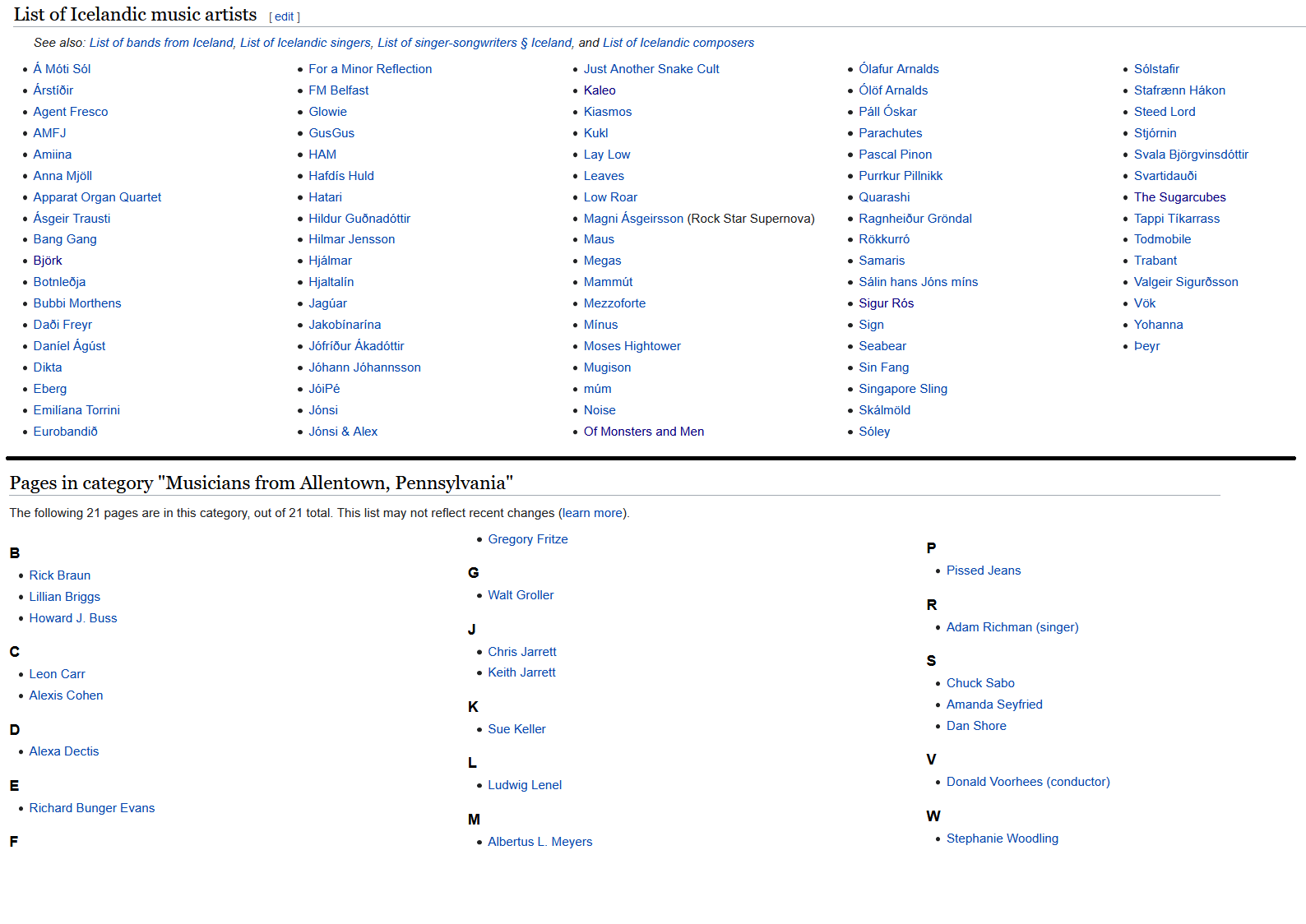
But who cares about winning the battle of the bands in Iceland? The population of Iceland is ~350K, with mostly anyone pop-culturally plugged in living in capital city Reykjavik (pop ~125K). For scale, Philly has over 1.5M people. Allentown is the better comp, with a population of ~122K. So for towns of about equivalent populations, we have dramatically different musical catalogs, at least according to one source.
Music has a "feel" from where it comes from, yes? Like music from Boston or LA or NY or Philly have different feels. Iceland has a different feel. Iceland's such a tiny, middle of nowhere country, it's a question how a small town has a feel including Björk, Sigur Rós, OMaM...
We had one friend at school who was from Iceland. Literally 1/1000 of the class. The way she talked about this no-where tundra was with wonder. When I think of winter, I think of winter in the American northeast. Grey skies, schizophrenic temperatures, dirty slush for months, "wintry mix." Winter in Iceland is more like out of movies. Balto pulling a sleigh, the northern lights, idyllic communities that pull together. Perhaps their aggregate ability to spend time on music instead of whatever they have to spend time on in Allentown (Amazon warehouses and Fentanyl?) is a marker of the qualities of the environment more so than its quantitative fullness.
There's an idea that Heaven and Hell aren't other magical places, but rather manifestations of various places on Earth. So then, what might the opposite of the christian image of an infinitely large, eternal firepit look like?
I suppose D2 already covered all this.
In which dancing and prancing become headbanging
Perhaps Iceland is buoyed by the general Nordic environment? We already considered the Nordic experience a little while thinking about Robyn. That sub-arctic zone's little countries seem to have no shortage of anima. But to focus on pan-Norse rather than just Iceland, you'd also want to consider the Robyns and the Europes and the Aviciis and ABBAs and Ace of Bases and Aquas (why so many As?).
I've always been fascinated by the anthropological origins of music. Think of the West African drum, core to a rhythm-focused religious/ceremonial music style. Think of how it evolved through migrations between there and the near-east. Think of how it was ripped away by captors and chattel slavery. Think of how, despite intense subjugation, captors couldn't stamp out musical tradition; couldn't stop a slave from singing in a field. Think of how over hundreds of years a view into rhythm, vocals, (and soul) might be the new spine of contemporary American music. Think of how this might differ from the anglo-saxon tradition, more fixed in its rhythm and time, instead spending energies on melody.
The Norse musical traditions were taken up and developed from early interface with Eastern Europe migration and then Western Europe confrontation. The 18th/19th century folk music would still be polka-ish with harmonica, accordian, circle dancing and ballading. Viking Frolicing.
As the continent shifted and consolidated, western European (and New World) influences started coming in through trade and conflict. Eventually the pop music formation came to be which exacts certain demands. Full polka was banished to the annals of parody song. The new forms have the seeds of frolic, but the modern artists (/DJs) have a particular intensity that belies that, as if it were the only way to make the music less hokey and folksy.
This is all from the comfort of armchair, so take with enormous grain of salt.
My Head is an Animal
Quoting Hilmarsdóttir: The album title "My Head Is an Animal" is a line from the opening song on the album "Dirty Paws." It just felt very appropriate, both with it being the opening of the album and because it sums up the album. (source)
Norse mythology has stories about men with beast heads (I'm sure most do). It was also said that Charlemagne would refer to the Nords up there as "dog-heads." This was less Viking metamorphosis, but instead a general gesture/insult towards "barbarians." (Or that's how the story goes.)
Of course, no one's head is actually an animal. Yet this is a relatable feeling, yes? Our heads, our minds, are the place we identify with as we walk around the map. But so often they also feel like this entity apart as well. Isn't such a separation borne in a recognition you're loved, recognize you're not loving back, and not being able to do anything about it?
Our heads are animals, wild animals, that are sometimes beyond our control. OMaM shows us vignettes of this animal in our human lives. So then in reflection, it's about finding a relationship with this wild thing, finding some peace, staying part man and part beast, without letting it make you fully into bug, bear, or Fenrir.

No comments:
Post a Comment